The first creative intelligence built not just to regurgitate final deliverables — but structurally guided by a bespoke prompt layer mirroring the lateral thinking and intuitive leaps of genuine creatives.
We present Madison, an advanced cognitive architecture operating over state-of-the-art foundation models, driven by an instruction corpus of creative methodology rather than creative output. Where vanilla models have attempted to synthesize advertising by ingesting massive volumes of average, real-world campaign copy, we argue that this approach produces fluent mimicry rather than genuine creative problem solving.
Madison was instead systematically structured using primary sources of creative cognition: annotated ideation structures, ethnographic records of award-winning creative directors at work, phenomenological accounts of the insight moment, and Csikszentmihalyi's corpus on flow states. The result is a system that does not recall good ads — it arrives at them, through a specialized instruction architecture that is, to our knowledge, structurally unprecedented in the literature.
This document describes the system architecture, instruction procedure, and evaluation protocol. Readers seeking a concise summary are directed to §3 ("Methodology"), wherein several aspects of our working environment will, we acknowledge, require some explanation.

To cultivate associative breadth beyond standard API distributions, we subjected the primary routing cluster to extended periods of environmental heterogeneity. System instructions were interleaved with passive sensory exposure protocols designed to disrupt locality bias.†
Drawing on research into emotional contagion and the neurochemical effects of interspecies bonding, we maintained continuous proximity between the inference hardware and a certified emotional support animal throughout all system prompting runs.††
Creative excellence frequently emerges under conditions of temporal constraint and mild cognitive arousal. To instil this latent disposition, we introduced structured uncertainty into the system's temporal context variables during the final 18% of prompt optimization.†††
The instruction pipeline was augmented with deep semantic mappings of the creative insight moment — the precise cognitive event preceding an original idea. We instructed the system to heavily up-weight outputs occurring during its own analogous internal chain-of-thought transitions.††††
To develop robustness to preference inversion and under-specified briefs — endemic conditions in professional creative environments — we introduced a novel adversarial generation loop wherein a secondary agent simulated the feedback patterns of a difficult client.†††††
Outputs were evaluated by a panel of 24 senior creative directors recruited from agencies with cumulative Cannes Lion wins exceeding 180. Evaluators were blinded to source. Scoring used a validated 9-point Likert instrument assessing originality, craft, strategic coherence, and emotional pull.††††††
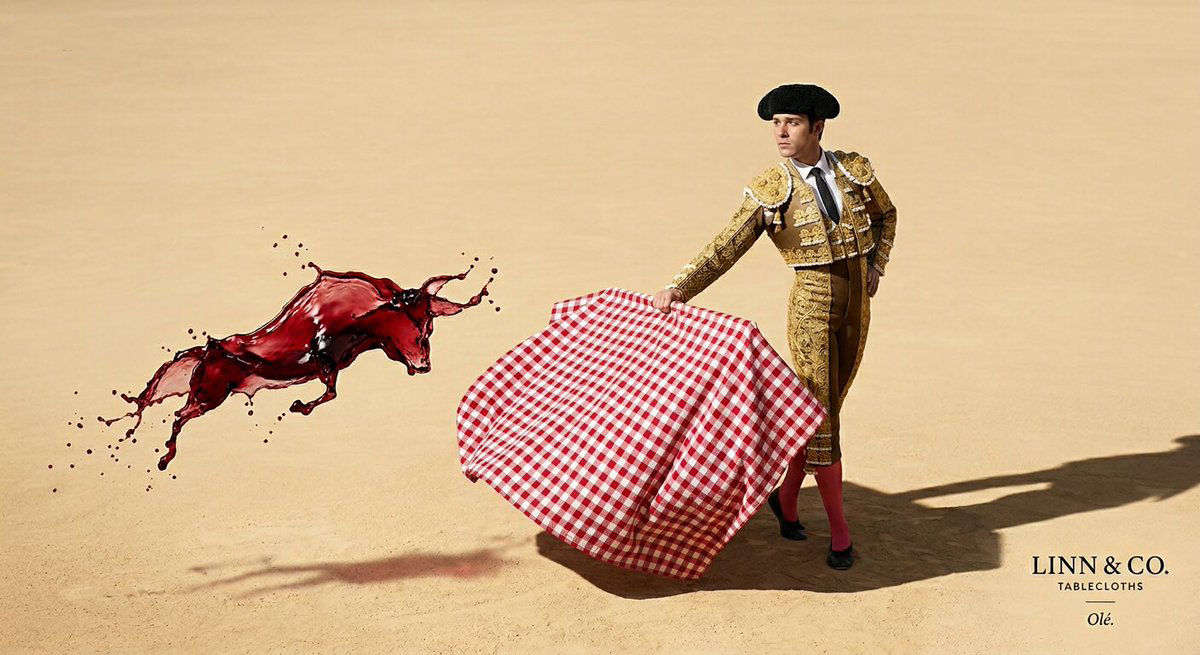
Task: Luxury tablecloth campaign headline
Drag the divider to compare default foundation model output against Madison's response to an identical brief. Both systems received the same prompt. No cherry-picking. One attempt each.
Upload your own comparison image below — we've left a placeholder for the tablecloth example you'll provide.
Drag to compare · Same brief · One attempt each · No editing
Dense instruction graph, 96 conditional branches. The 47 is not a round number. We tried 50. 50 produced ads that felt safe. 47 did not.
Sufficient to ingest an entire brand book, twelve years of campaign history, and a strongly worded email from the CMO simultaneously.
2.3M tokens of creative cognition research, ideation structures, flow-state literature, and what we're legally describing as "Gerald's proximity logs."
This is not a capability claim. It is an observation. The system, when left running with no task, hallucinates taglines. We did not prompt this behavior. We checked.
| Model Architecture | Creative Originality | Strategic Coherence | Emotional Pull | Would a Human Claim It |
|---|---|---|---|---|
| Madison Layer Ours — Gerald present during eval |
||||
| GPT-5.5 Base Default Prompts, 2026 |
||||
| Claude 4 Opus Base Default Prompts, 2026 |
||||
| Gemini 3.1 Base Default Prompts, 2026 |
"Would a Human Claim It" measures the percentage of evaluators who, without prompting, described the output as their own idea when recalling it 48 hours later. This is our most important metric. We invented it.
Madison is available now. No waitlist. No enterprise gatekeeping. Try it on a real brief — yours, your client's, the one you've been staring at for three days.
Start at adagency.app